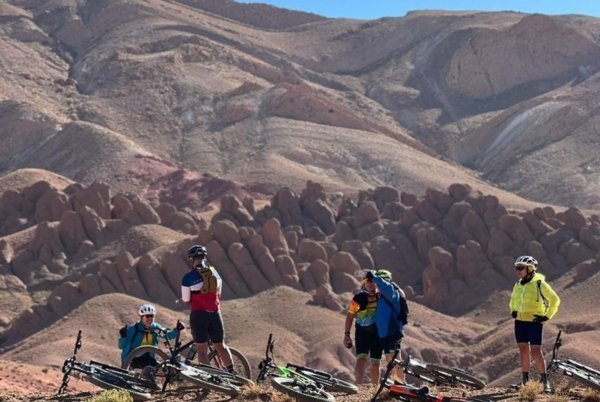
Explore Jbel Saghro on a mountain bike. Ride through lunar landscapes, volcanic rock towers at Bab n’Ali, and remote nomad canyon paths.
South of the High Atlas, across the Tizi n’Tichka, the world changes geology and mood. Jbel Saghro — "the dry mountain" — is a volcanic range of black rock towers, shattered plateaux, and canyons that see almost no visitors. For mountain bikers who want wilderness with a capital W, it is the finest winter riding on earth. We know it valley by valley.
The Volcanic Beauty of Jbel Saghro
Saghro is what Morocco looks like before anyone arrives. Sixty million years of volcanic erosion have left organ-pipe spires, tabletop mesas, and slopes of black scree that shimmer with heat in the afternoon. There are no roads across the interior — only paths, and the mountain bikers who follow them.
The light is the thing riders remember. At dawn the rock is charcoal; by nine it is rust; by sunset it burns. Photographers chase this palette in Iceland and Utah. Here you ride through it.
Key Landmarks: Bab n’Ali Rock Pinnacles & Iknioun Pass
Bab n’Ali — "the gate of Ali" — is Saghro’s signature: two volcanic towers standing like gateposts above a canyon that the trail threads beneath. The ride through the gate and down the far canyon is the single most photographed MTB moment in Morocco, and it earns every click.
The Iknioun Pass (2,500 m) is the high traverse: a nomad path crossing the range’s spine with 360° views from the snow Atlas in the north to the Sahara haze in the south. The descent off the pass is 900 m of linked singletrack to a palm oasis — the best hour of trail in the range.
Trail Characteristics & Technical Level
- Terrain: 50% singletrack and mule path, 40% piste, 10% dry riverbed — rocky throughout.
- Difficulty: 3–4 of 5. Sustained climbing, technical descending, no bail-out roads.
- Daily distance: 35–55 km with 600–1,000 m climbing — remoteness, not speed, is the challenge.
- Bike: full suspension recommended; hardtails work for strong riders on the piste-heavy variants.
Why Winter & Early Spring are the Best Times to Ride Saghro
Saghro in summer is a furnace — 45 °C in the canyons, and we do not ride it. From October to April it is a different mountain: 20–25 °C days, cold star-filled nights, and the nomad families camped in the low valleys with their goats, exactly as they have for centuries. Winter is not the off-season in Saghro; it is the season.
This makes Saghro the perfect yin to the Atlas yang: when the Toubkal valleys are under snow, the volcanic south is at its absolute best. A winter week can even combine both — snow-line riding in the Atlas, then two days south of the pass in the sun.
Our MTB tours include multi-day Saghro traverses with 4x4 support, a mechanic, and nights in nomad camps and small gîtes. It is the wildest riding we offer, and the one guests write to us about years later.
Ask us on WhatsApp about Saghro conditions — water levels in the river crossings change month to month, and we ride it before we send anyone.
Ready to ride?
Let’s plan your Atlas adventure.
Tell Atlas Bike Tours your travel dates, riding experience and preferred terrain so we can suggest a suitable ride from Marrakech or Imlil.